A Short Introduction to the Coffee Culture of Prague

🇬🇧 Where Bohemian Spirit Meets a Viennese Legacy
Coffee in Europe has always been more than a drink. It is a ritual, a meeting point, a spark for ideas. Few places capture this better than Prague and Vienna, two cities whose café traditions grew side by side, shaped by empire, art and a little mythology.
🇩🇪 Wo böhmischer Geist auf wienerische Tradition trifft
Kaffee ist in Europa viel mehr als nur ein Getränk. Er ist Ritual, sozialer Kitt und Inspiration. Kaum zwei Städte verkörpern das besser als Prag und Wien, zwei Metropolen mit eng verflochtener und doch eigenständiger Kaffeehauskultur.
🇬🇧 From Ottoman routes to Central Europe
Coffee reached Europe through Venetian traders in the 17th century. Vienna quickly became one of its strongholds, helped by the legendary tale of the 1683 Battle of Vienna, where sacks of coffee were supposedly found in the abandoned Ottoman camp. Whether fact or folklore, the story sealed Vienna’s early reputation as a coffee capital.
Prague entered the scene shortly after. In 1714 the city welcomed its first café, opened by the Arab merchant Georgius Deodatus Damascenus. From there, coffee houses spread across the Habsburg lands and each city added its own character.
Café society: Prague vs Vienna
Vienna shaped a unique coffeehouse identity with elegant rooms, marble tables, newspapers on wooden holders and a famously unhurried pace. These cafés became creative sanctuaries for writers, artists and thinkers. The culture became so significant that UNESCO added Viennese coffeehouse tradition to its list of intangible heritage.
Prague’s cafés evolved differently. By the late 19th and early 20th century the city’s Bohemian soul was beating inside places like Café Slavia, Café Louvre and Café Imperial. Franz Kafka, Karel Čapek and generations of dissidents treated cafés as living rooms where ideas were exchanged and the status quo was quietly challenged. In Prague the café was never just a place to drink coffee. It was a stage for culture, creativity and subtle rebellion.
Third wave coffee in modern Prague
Today Prague’s coffee culture is thriving more than ever. While grand historic cafés still enchant visitors, a new wave of specialty coffee bars has transformed the city. Independent roasters, precision focused baristas and minimalist interiors inspired by Nordic design now shape much of the scene. Onesip Coffee, Můj šálek kávy and Café Letka are just a few names that represent modern Prague, open minded and passionate about quality.
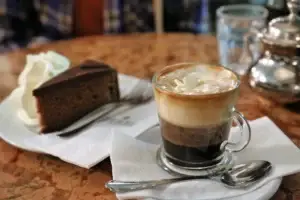
Vienna continues to honour its long established traditions. Order an Einspänner served on a silver tray, take your time and feel the weight of history in every moment.
Conclusion
Whether you are sipping a perfectly pulled espresso in Prague’s Karlín district or enjoying a velvety melange under the chandeliers of Vienna’s Ringstrasse, you are tasting more than coffee. You are experiencing centuries of stories, rituals and regional identity, a journey brewed in Central Europe.
🇩🇪 Von osmanischen Handelswegen nach Mitteleuropa
Im 17. Jahrhundert gelangte der Kaffee über venezianische Handelswege nach Europa. Wien wurde schnell zu einem zentralen Hotspot. Die berühmte Geschichte über die Schlacht um Wien 1683 erzählt von angeblich gefundenen Kaffeesäcken im verlassenen Lager der osmanischen Armee. Mythos oder Wahrheit, diese Erzählung prägte Wiens frühen Ruf als Kaffeestadt.
Kurz darauf betrat auch Prag die Bühne. Im Jahr 1714 eröffnete der arabische Kaufmann Georgius Deodatus Damascenus das erste Prager Kaffeehaus. Von dort aus verbreitete sich die Kaffeehauskultur in den Habsburger Ländern und jede Stadt entwickelte ihren eigenen Stil.
Kaffeehauskultur: Prag vs Wien
Wien entwickelte eine besondere Kaffeehauskultur mit eleganten Räumen, Marmortischen, Zeitungen auf Holzhaltern und bewusst langsamem Service. Diese Orte wurden zu Treffpunkten für Schriftsteller, Künstler und Denker. Die Tradition wurde so bedeutend, dass die UNESCO sie als immaterielles Kulturerbe auszeichnete.
In Prag erhielt das Café einen stärker künstlerischen und oft leicht rebellischen Charakter. Ende des 19. und Anfang des 20. Jahrhunderts pulsierte das intellektuelle Leben in Lokalen wie Café Slavia, Café Louvre oder Café Imperial. Franz Kafka, Karel Čapek und später viele Dissidenten nutzten diese Cafés als Wohnzimmer, Diskussionsräume und kulturelle Rückzugsorte. In Prag war das Kaffeehaus immer ein Ort für Kultur, Kreativität und stillen Widerstand.
Third-Wave-Kaffee im modernen Prag
Heute erlebt Prag eine neue Blüte der Kaffeekultur. Die historischen Grand Cafés beeindrucken weiterhin Besucher, doch parallel dazu hat sich eine lebendige Third Wave Szene etabliert. Unabhängige Röstereien, präzise arbeitende Baristas und minimalistische Cafés mit nordischer oder industrieller Ästhetik prägen das moderne Stadtbild. Onesip Coffee, Můj šálek kávy und Café Letka stehen für dieses offene und qualitätsbewusste Prag.
Wien bleibt seiner Tradition treu. Ein Einspänner auf dem Silbertablett und stundenlanges Verweilen machen die Geschichte v každém Moment spürbar.
Fazit
Ob ein präzise gezogener Espresso im Prager Stadtteil Karlín oder eine Melange unter den Kronleuchtern der Wiener Ringstraße, beides ist mehr als ein Getränk. Es ist eine Reise durch Geschichte, Geschmack und mitteleuropäische Identität.